Beyond Visible Mending – Fixing Broken Jeans

Two years ago, I published a post – Little Black Overdress – in which I talked about the fact I decided not to buy anymore clothes. Instead, I would make them myself – sew them by hand. I published that post in October of 2021. Since then, I have made only a few new garments. Mostly I am still wearing what I was wearing then. Things are older, more worn, some threadbare in places, tearing, already torn. My jeans, in particular, need mending. This is a post about mending my jeans.

All of my jeans are the same. They are Free People Extreme Flairs, a style that was discontinued several years ago. They were all, originally, a plain, pale blue, lightweight denim. My friend Rita Petteys (@ritapetteys) dyed them for me; I sent them all to her with only the request that she do ‘something fabulous.’ Each pair she dyed is different. The pair pictured above is the only pair with lozenge-shaped rings of resist where she bound the fabric before dyeing. As my jeans have aged, the fabric has become thin along the center back seam and at the corners of the pockets. So mending can’t be put off any longer.

I started working on a pink pair first, using rectangular patches to cover small holes and thin areas. But I found the rectangles boring, though perfectly functional. So I decided to make spiral-shaped patches that I cut out free-hand. The first one I made looked like it was climbing out of my pocket, which made it feel very cheerful; it helped that it was a bright green. My turned-under edges created the space within the spiral that revealed the shape.

To follow is a speeded-up video of my stitching on one of the spiral patches with another pinned in place but not yet stitched.

From there, I started to experiment with an applique pattern I had developed for another project. My objective was to accomplish the stabilization of existing damage that I needed, pre-empt damage by reinforcing thin areas, and do something ornamental that I would enjoy visually and also enjoy sewing.

The video below tells the story of my shift from spirals to floral appliques and introduces an experiment I tried afterward.

In the experiment I described wanting to try in the video (I outlined my patch shape with a running stitch before cutting it out and attaching it to my jeans), I found that the stay-stitching did not make as big a difference in the curviness of my finished lines as did my practice with the shape.

In the image above, you can see how I traced around my oaktag pattern onto my patch fabric with a fine-tip sharpie. The top blue shape is simply traced. The bottom blue shape is traced then stay-stitched. The shape below has been traced, stay-stitched, and then cut out, ready to attach to a pair of jeans.

I got better at creating a curvy line the longer I worked. Based on that experience, I suggest swatching your full appliques on test fabric or on relatively lower-stakes mending projects before putting them on garments you value and the look of which is important to you.

What all of this jeans-mending has led me to is a methodology for fixing damage and reinforcing weak areas and stress points that is also more than just mending. The patching method I have worked out for myself adds surface embellishment that looks intentionally decorative for its own sake rather than simply functional as repair. I like that. I want that sense of visual interest that is also utilitarian without proclaiming itself, in its form, to be merely practical. My floral and spiral patches take more time than a rectangle to sew onto the jeans. They also add considerable excitement and freshness to what is an ageing cohort of garments that needs to last until I figure out what I’m going to do next for pants.

Here are the steps I took, which can be used for any garment, not just broken jeans:

1. Identify and map the damage
2. Assess salvageability
3. Mend tears and reinforce weak areas – basic stitches and invisible patching
4. Design the visible mend – create decorative patches specific to the damage
5. Applique – basic stitches for pretty patches
6. Embroidery as supplemental surface embellishment and additional reinforcement
First Knitting

I was seven when my mother taught me how to knit.  She learned from her aunt Elma. I don’t know exactly what the kinship arc was that connected my mother to Elma and made Elma my mother’s aunt and for this story it doesn’t matter.

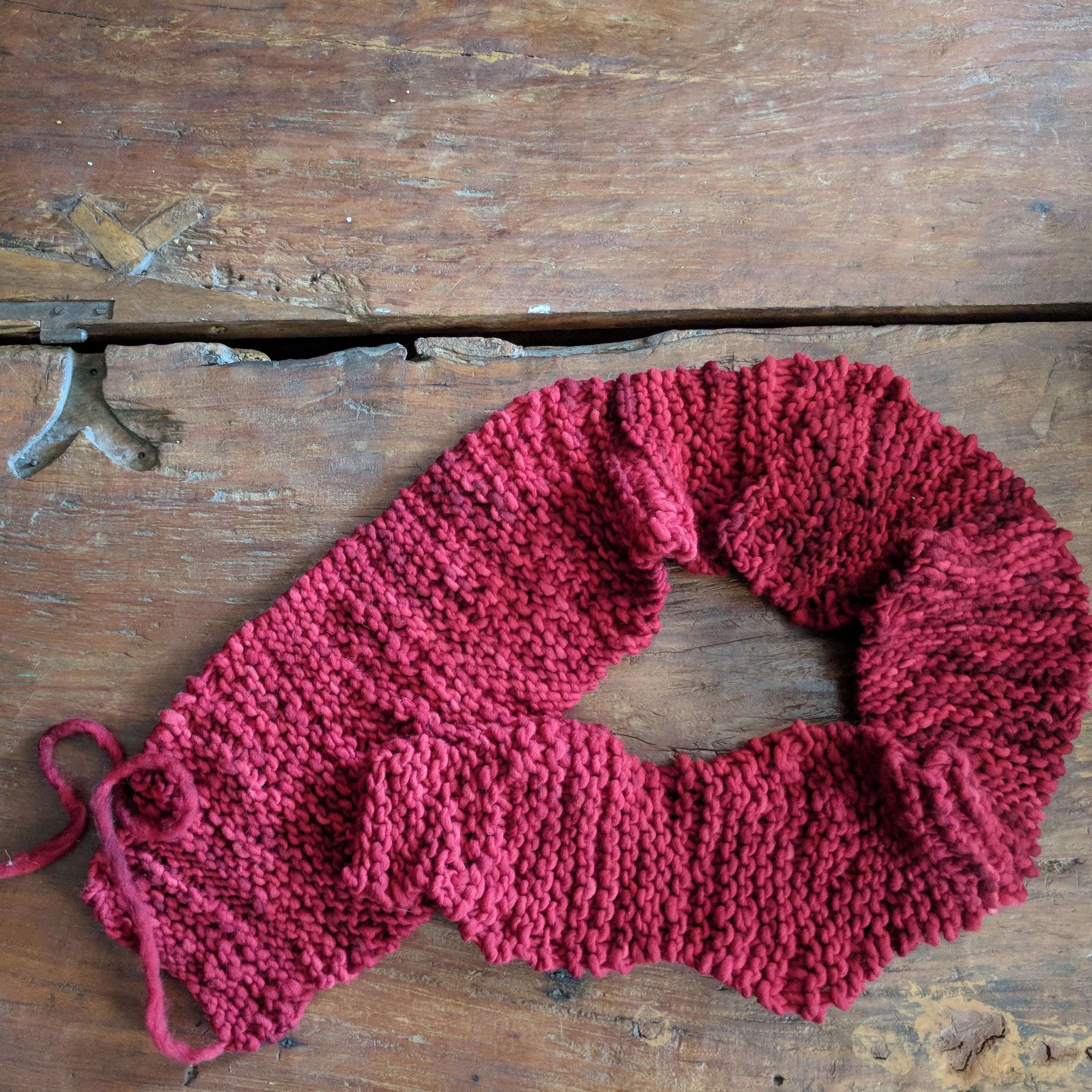
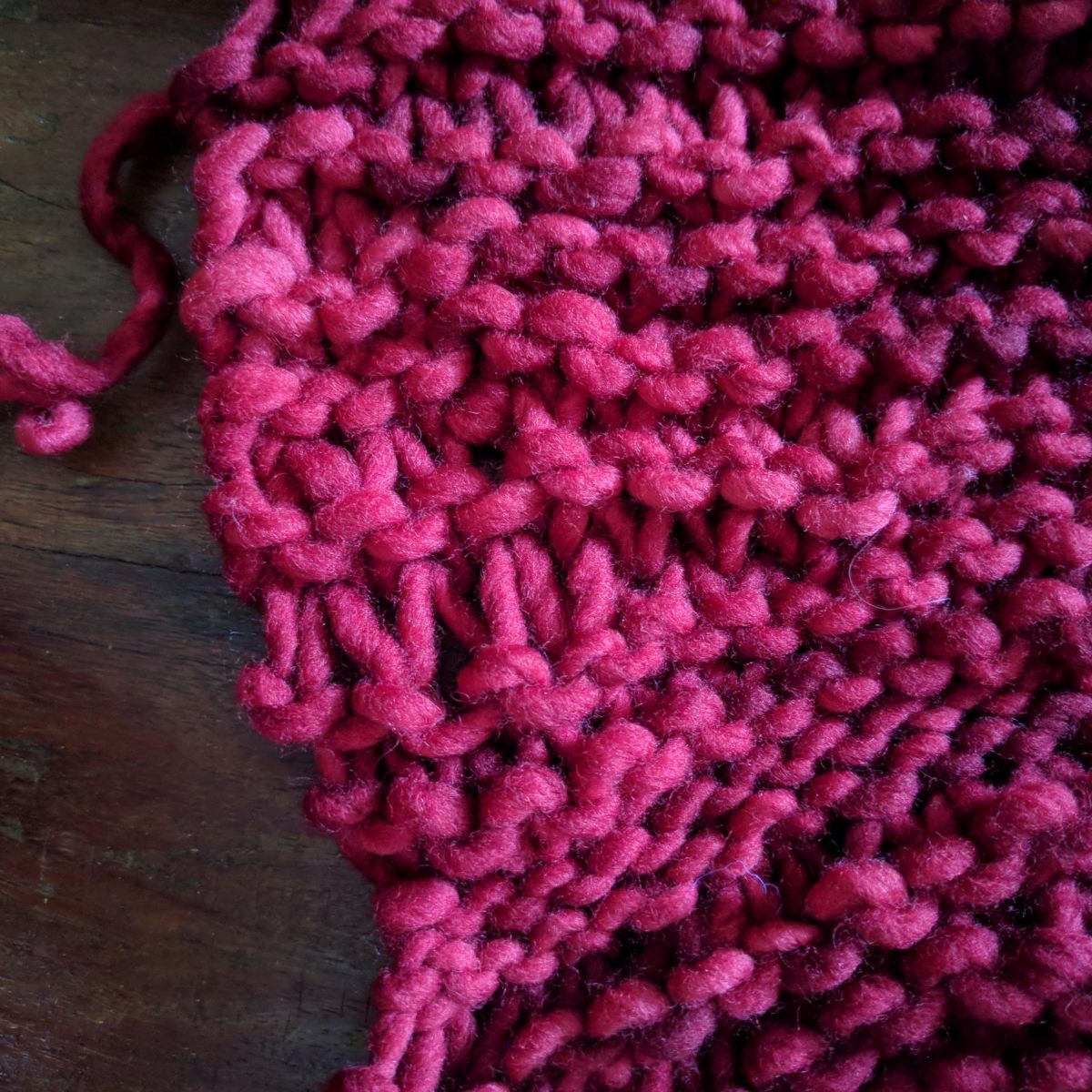
I don’t remember the learning-to-knit part.  I remember the first project once it was done.  It was white wool, a short scarf, and very uneven and badly shaped in the way first knitting projects can be – wide at the start and loose, narrowing to the center and way too tight, then widening again as I tried to rectify the tightness in the center.  Some stitches were too big, others too small.  It didn’t look like my mother’s even knitting.

I gave it to my father as a gift.  It was soft and I guess I must have been proud enough to have made it that I could give it to my dad even though, when compared to fine knitting, it was clearly no good.

My father wore it.  That amazed me.  That he wore that no-good first-knitting little white neck warmer totally amazed me.  He would fold one side over the other to cover his neck.  The narrow part fit at the back of his neck.  The two wide ends came down to the top of his chest.  Then he’d put on his coat.  As I remember it, he wore it alot.  And even if that is a bit of hyperbole my amazement wrought, I’ll take it.

I decided to re-create that first scarf.  My motivation was simple enough.  I thought about how, if it is sufficiently inept, a first project can alienate one from trying again.  When we face real difficulty in achieving a goal of mastery, we may decide we are no good at it, are lacking in some fundamental talent that other people clearly have but which to us is inaccessible or elusive.  We hold our first-starting-out selves up against those with years of experience and find ourselves so lacking that we lose hope and lost interest.  The thing is no good.  It’s no use.  It’s unwearable.

The fact that my father wore that badly-knit scarf his little daughter made gave me the confidence to execute the next project, which was better.  Even if the scarf was unwearable to me, it was not unwearable to my father.

But I contend that an unwearable scarf -from the perspective of even tension and a consistent number of stitches – can become wearable if it is styled well.  The unintentional can be wrestled into submission to intention with the right approach and good tools. The first scarf can take us from ambivalent about the issue of our first efforts to more than proud: stylish.

This transformation is what I work for.  It’s my job.  I design and produce accessories. The justification for my work, my company, is my need, your need, for tools to turn handmade fabrics (knitted, crocheted, handwoven) and purchased garments into beautiful wearables that show the fabric off and make the wearer feel beautiful in addition to looking stylish.

My closures should make your life in fiber-wear easier.  I want the same things you want.  I want to look good without thinking about it too much.  I want to go about my days undistracted by difficulties with my clothes.  I don’t want my scarves falling off and catching in drawers when I bend over.  I don’t want my shawl to slide off one shoulder and require re-arranging many times a day.

I felt sure that I could take a first scarf, of the kind I made when I was 7 years old, from wonky to wonderful with a few screw-in closures.  So I cast on.

img_20180608_103939

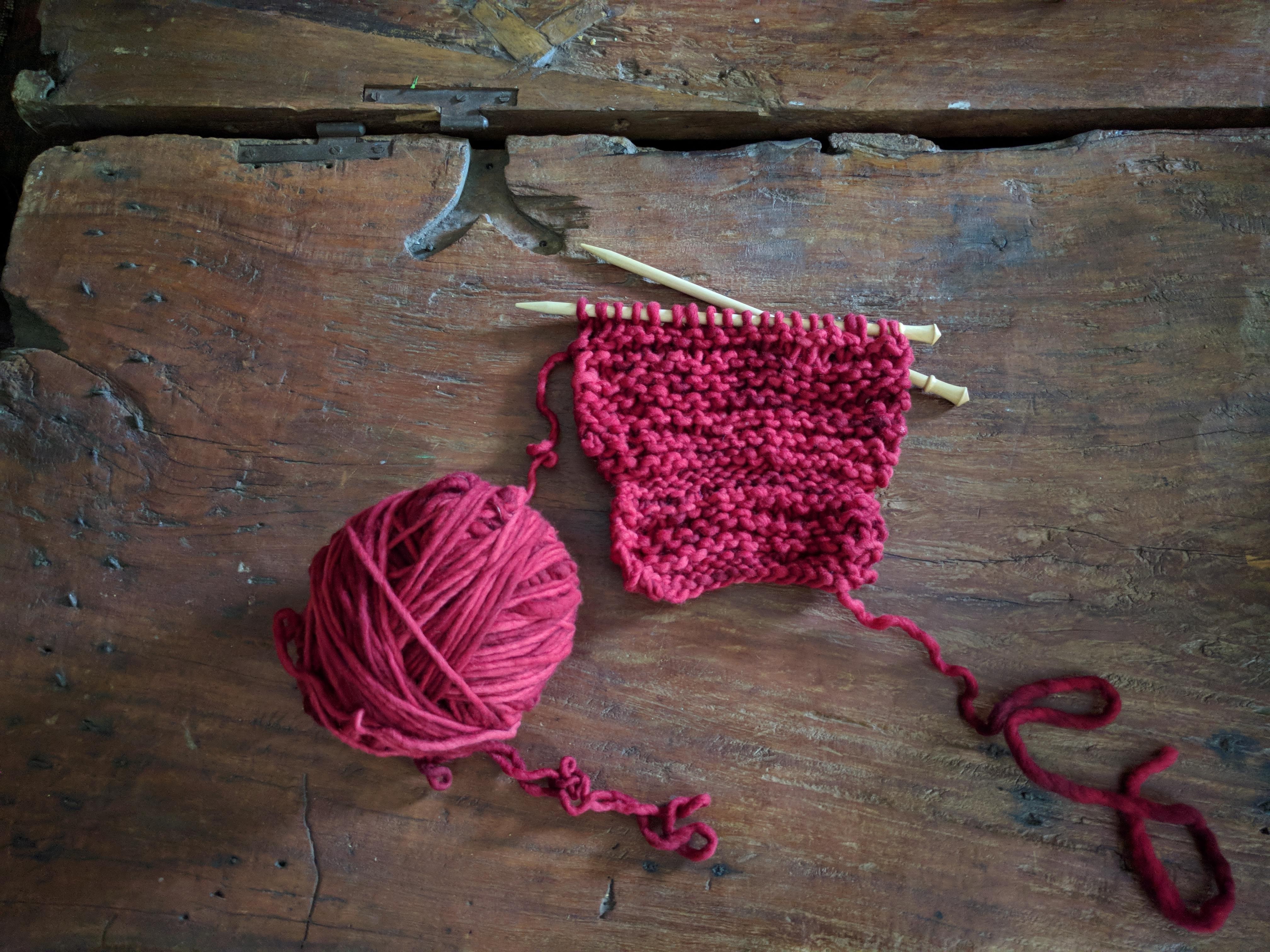
It’s hard to return to a pre-control moment when you can’t achieve an even tension, have trouble discerning where a stitch begins and ends, and haven’t yet learned to purl. I got better at inconsistency and wonky as time went on.  Well, that’s not quite true.  Because I was working toward inconsistency, in a sense I became more consistent in my achievement of inconsistency.  Even naive execution contains the possibility of mastery.

img_20180618_153544_403

So I finished it. The end with the cast-on yarn trailing, is where I started.  The increase of stitches to make the scarf slightly wider was fairly subtle.  I wanted it to be more extreme.  My inconsistency in tension was not enough.  I pushed it harder.  By the time I finished, I felt I had begun to master the first scarf.  If I make another, I’ll do even better at bad knitting.

Now comes the interesting experiment – adorning the first scarf so it becomes an enviable style piece, a fabulous example of hand-knit art you might expect in a high-end chic boutique. This is my goal.

What is your first-knitting story? I would love to hear it.  You are welcome to tell me about it in a comment.

If you want to start growing your style toolkit, go to juldesigns.com

Check out my instagram @jul_designs to see how I have styled this Simulation and get 15% Off the Pedestal Buttons and screw-in closures in the Cordoba Series when you use coupon code FIRSTSCARF.